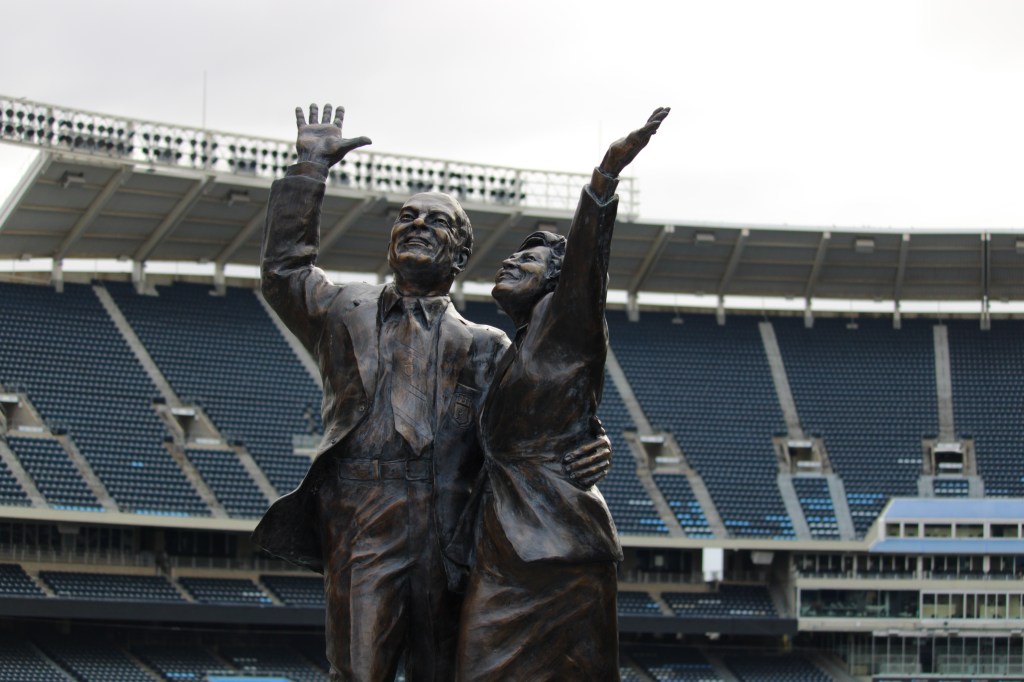
When Kansas City was desperate to keep its rich baseball history growing, it needed someone to step up. After some searching, Ewing Marion Kauffman became the man to step up and deliver.
Through Kauffman’s founding and ownership of the Kansas City Royals, he added another layer to Kansas City’s already rich baseball history over the course of a quarter of a century.
“Mr. K was not necessarily a huge baseball fan,” Royals Hall of Fame director Curt Nelson said. “He viewed it more as a community asset.”
After graduating from Westport High School in 1934, Kauffman traveled around doing odd jobs until returning to get his business degree from the Junior College of Kansas City. He later joined the Navy and served in World War II.
Moving to Kansas City at a young age, Kauffman quickly developed a love for KC because the city provided so many wonderful experiences and opportunities.
“He always thought that Kansas City was important to his success,” Nelson said.
Once returning to Kansas City after serving in World War II, Kauffman got a pharmaceutical job and later started his own company, Marion Laboratories, which became a multi-billion dollar company.
In 1962, Kauffman married his wife, Muriel, whom he met at Marion Laboratories.
As the Athletics were preparing a move to Oakland, Kansas City was searching for someone who could finance an MLB expansion team. In 1967, Kauffman agreed to finance the team and was announced as Royals owner in 1968.
“He immediately said that he did not
Kurt Nelson, Royals Hall of Fame director
view the team as his, he viewed the
team as Kansas City’s.”

“That’s always the way he pursued it, with the idea that he was to steward this and then eventually pass it on to somebody else and make sure Major League Baseball stayed in Kansas City,” Nelson said.
In 1967 a bond issue assured Kansas City of a new stadium, which also helped to negotiate an MLB expansion team for KC with the Athletics leaving. The only question was the type of stadium.
One of the first ideas that gained traction was building a multi-use dome stadium, similar to the Astrodome that had recently been built in Houston. That idea was eventually scrapped for Truman Sports Complex with Arrowhead Stadium opening in 1972 and Royals Stadium opening in 1973.
Shortly after the Royals opened play in 1969 at Municipal Stadium, Kauffman developed the Royals Baseball Academy in Florida. This unique baseball development system brought Royals great Frank White to Kansas City.
Royals Stadium was renamed Kauffman Stadium in July 1993, just two months before Kauffman’s passing after a battle with bone cancer. His wife, Muriel, passed away in 1995.
Once the Royals were sold, Kauffman had set up for the proceeds of the sale to go to charities in Kansas City.
The Royals’ most successful years came in the 24 years that Kauffman served as owner, winning a World Series, two American League pennants, six division titles with a total of seven playoff appearances and 16 winning seasons. Since Kauffman’s passing, the Royals have a World Series, two American League pennants, one division title, two playoff appearances and five winning seasons.
Kauffman overcame all of the obstacles that came with being an expansion team to create a winning environment quickly. Without Mr. K, the Royals have struggled to win.
Kauffman’s Royals legacy was important. It was based around executing what he said he was going to do. That was not just keeping a Major League team in KC, but keeping a winning Major League team in KC that was fully used as a community asset.
Kauffman’s legacy is much deeper than just his contributions to the Kansas City Royals. Both Ewing and Muriel Kauffman’s contributions to Kansas City still have a lasting impact through the foundations still around today.
“Mr. K had that from the very beginning,” Nelson said. “That idea of stewardship of this community asset continues on into the current ownership even where Mr. Sherman (Royals majority owner) serves on the board of the Kauffman Foundation.”


[…] Ewing Kauffman: Stepping up to the plate […]
LikeLike
[…] club began play as an MLB expansion franchise in 1969 under the ownership of Ewing Kauffman. They started at Municipal Stadium before moving to the Truman Sports Complex in […]
LikeLike